
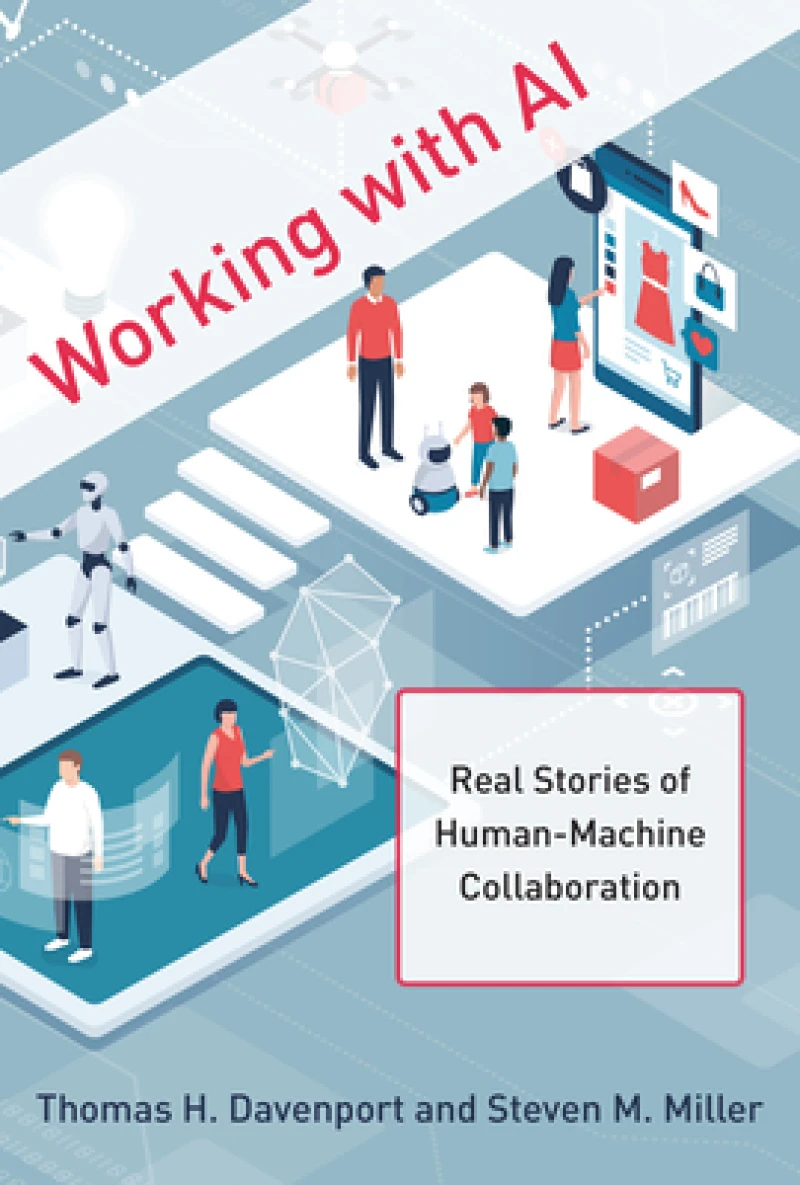
Working with AI : Real Stories of Human-Machine Collaboration
Book Details
Format
Hardback or Cased Book
Book Series
Management on the Cutting Edge
ISBN-10
0262047241
ISBN-13
9780262047241
Publisher
MIT Press Ltd
Imprint
MIT Press
Country of Manufacture
US
Country of Publication
GB
Publication Date
Sep 27th, 2022
Print length
312 Pages
Weight
588 grams
Dimensions
16.40 x 23.80 x 3.00 cms
Product Classification:
Economics
AI Summary
Ksh 5,750.00
Werezi Extended Catalogue
Delivery in 14 days
1 copies in stock
Delivery Location
Delivery fee: Select location
Delivery in 14 days
Secure
Quality
Fast
Two management and technology experts show that AI is not a job destroyer, exploring worker-AI collaboration in real-world work settings. This book breaks through both the hype and the doom-and-gloom surrounding automation and the deployment of artificial intelligence-enabled—“smart”—systems at work. Management and technology experts Thomas Davenport and Steven Miller show that, contrary to widespread predictions, prescriptions, and denunciations, AI is not primarily a job destroyer. Rather, AI changes the way we work—by taking over some tasks but not entire jobs, freeing people to do other, more important and more challenging work. By offering detailed, real-world case studies of AI-augmented jobs in settings that range from finance to the factory floor, Davenport and Miller also show that AI in the workplace is not the stuff of futuristic speculation. It is happening now to many companies and workers. These cases include a digital system for life insurance underwriting that analyzes applications and third-party data in real time, allowing human underwriters to focus on more complex cases; an intelligent telemedicine platform with a chat-based interface; a machine learning-system that identifies impending train maintenance issues by analyzing diesel fuel samples; and Flippy, a robotic assistant for fast food preparation. For each one, Davenport and Miller describe in detail the work context for the system, interviewing job incumbents, managers, and technology vendors. Short “insight” chapters draw out common themes and consider the implications of human collaboration with smart systems.
Two management and technology experts show that AI is not a job destroyer, exploring worker-AI collaboration in real-world work settings.
This book breaks through both the hype and the doom-and-gloom surrounding automation and the deployment of artificial intelligence-enabled—“smart”—systems at work. Management and technology experts Thomas Davenport and Steven Miller show that, contrary to widespread predictions, prescriptions, and denunciations, AI is not primarily a job destroyer. Rather, AI changes the way we work—by taking over some tasks but not entire jobs, freeing people to do other, more important and more challenging work. By offering detailed, real-world case studies of AI-augmented jobs in settings that range from finance to the factory floor, Davenport and Miller also show that AI in the workplace is not the stuff of futuristic speculation. It is happening now to many companies and workers.
These cases include a digital system for life insurance underwriting that analyzes applications and third-party data in real time, allowing human underwriters to focus on more complex cases; an intelligent telemedicine platform with a chat-based interface; a machine learning-system that identifies impending train maintenance issues by analyzing diesel fuel samples; and Flippy, a robotic assistant for fast food preparation. For each one, Davenport and Miller describe in detail the work context for the system, interviewing job incumbents, managers, and technology vendors. Short “insight” chapters draw out common themes and consider the implications of human collaboration with smart systems.
This book breaks through both the hype and the doom-and-gloom surrounding automation and the deployment of artificial intelligence-enabled—“smart”—systems at work. Management and technology experts Thomas Davenport and Steven Miller show that, contrary to widespread predictions, prescriptions, and denunciations, AI is not primarily a job destroyer. Rather, AI changes the way we work—by taking over some tasks but not entire jobs, freeing people to do other, more important and more challenging work. By offering detailed, real-world case studies of AI-augmented jobs in settings that range from finance to the factory floor, Davenport and Miller also show that AI in the workplace is not the stuff of futuristic speculation. It is happening now to many companies and workers.
These cases include a digital system for life insurance underwriting that analyzes applications and third-party data in real time, allowing human underwriters to focus on more complex cases; an intelligent telemedicine platform with a chat-based interface; a machine learning-system that identifies impending train maintenance issues by analyzing diesel fuel samples; and Flippy, a robotic assistant for fast food preparation. For each one, Davenport and Miller describe in detail the work context for the system, interviewing job incumbents, managers, and technology vendors. Short “insight” chapters draw out common themes and consider the implications of human collaboration with smart systems.
Get Working with AI by at the best price and quality guaranteed only at Werezi Africa's largest book ecommerce store. The book was published by MIT Press Ltd and it has pages.
Discover books you might love based on this title.
More in This Genre

A Short Fiscal and Financial History of England, 1815-1918
Ksh 26,950.00

American Power and the Prospects for International Order
Ksh 9,900.00

Follow the Money
Ksh 3,050.00

Die Grenzueberschreitende Wirkung Von Nationalen Verwaltungsakten
Ksh 6,250.00

Routledge Handbook of Sport and COVID-19
Ksh 8,900.00

Routledge Handbook of Chinese Business and Management
Ksh 42,300.00
