
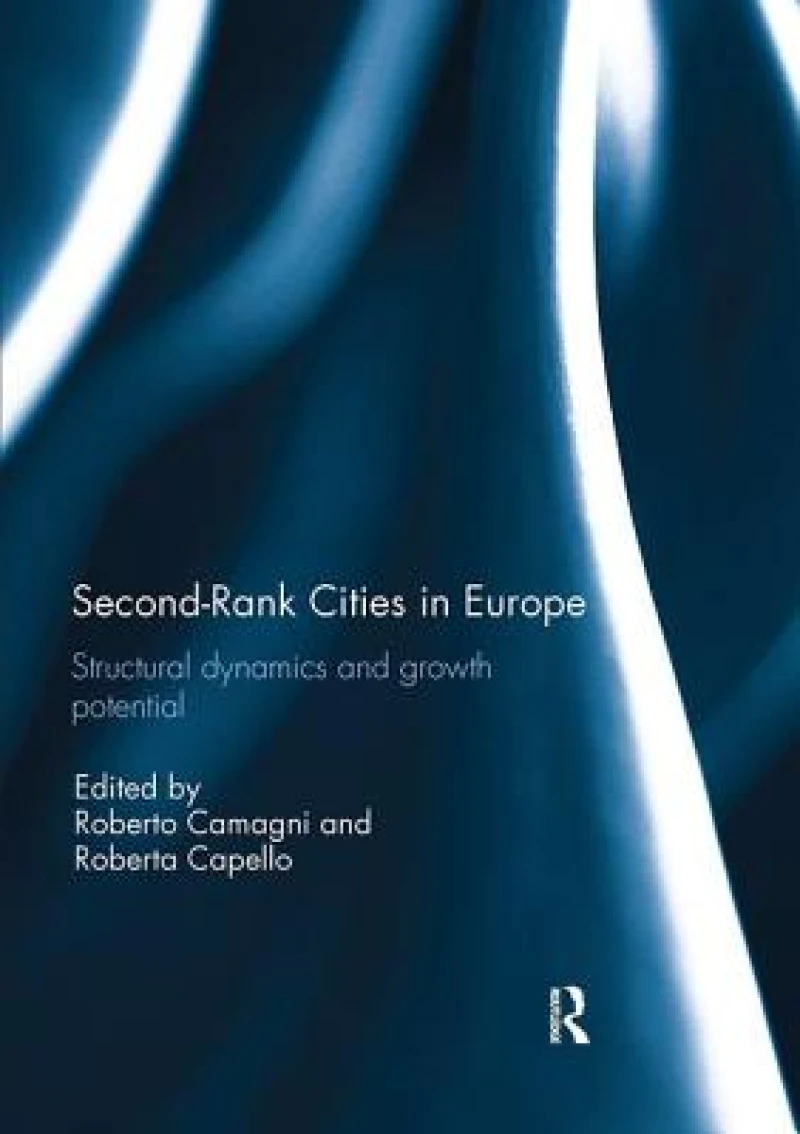
Second Rank Cities in Europe : Structural Dynamics and Growth Potential
Book Details
AI Summary
Delivery Location
Delivery fee: Select location
In periods of economic downtown, it is second-rank cities which outperform first-rate cities, recording annual GDP growth rates which are much less negative than those of their capitals. In explaining this phenomenon, linking urban dynamics to agglomeration theories seems the most interesting approach. This volume claims that interpretation of current dynamics in European urban systems would benefit from exploiting the traditional concept of agglomeration economies, expanding it to investigate the missing link between agglomeration economies and urban dynamics. This book was originally published as a special issue of European Planning Studies.
Second-rank cities are back on the academic scene, capturing the interest of scholars with their unexpected recent performance with respect to first-rank cities. Looking at the data on average urban GDP growth in 139 European cities since 1996, the relatively strong position of large cities (over 1.5 million inhabitants) on national growth coincides with the periods of fastest expansion, while at times of slowdown second-rank cities prevail. Especially in the recent period of economic downturn, second-rank cities have recorded annual GDP growth rates much less negative than those of capital cities; and in some European countries, like Austria and Germany, all cities have outperformed their capitals.
In explaining this phenomenon, linking urban dynamics to agglomeration theories seems the most interesting approach. However, merely to link agglomeration economies to urban size in order to interpret urban performance is neither convincing nor sufficient, and it calls for additional investigation into how agglomeration economies work. This volume claims that interpretation of the current dynamics in European urban systems – especially in the western part of Europe – would benefit from exploitation of the traditional concept of agglomeration economies. However, necessary for this purpose are more in-depth considerations on the nature, scope, intensity, and causes of agglomeration economies which do not relate their existence solely to urban size. And this is where the main challenge for scholars lies, in the interpretation of the missing link between agglomeration economies and urban dynamics. This book was originally published as a special issue of European Planning Studies.
Get Second Rank Cities in Europe by at the best price and quality guaranteed only at Werezi Africa's largest book ecommerce store. The book was published by Taylor & Francis Ltd and it has pages.
Discover books you might love based on this title.
More in This Genre

The Breaking Point
Ksh 4,250.00

Die rechtliche Steuerung urbanen Wandels
Ksh 20,600.00

Sabelo Ndlovu-Gatsheni and African Decolonial Studies
Ksh 27,900.00

Understanding Cryptocurrencies
Ksh 3,250.00

Quantitative Remote Sensing
Ksh 23,400.00

Lionel Robbins on the Principles of Economic Analysis
Ksh 27,900.00
