
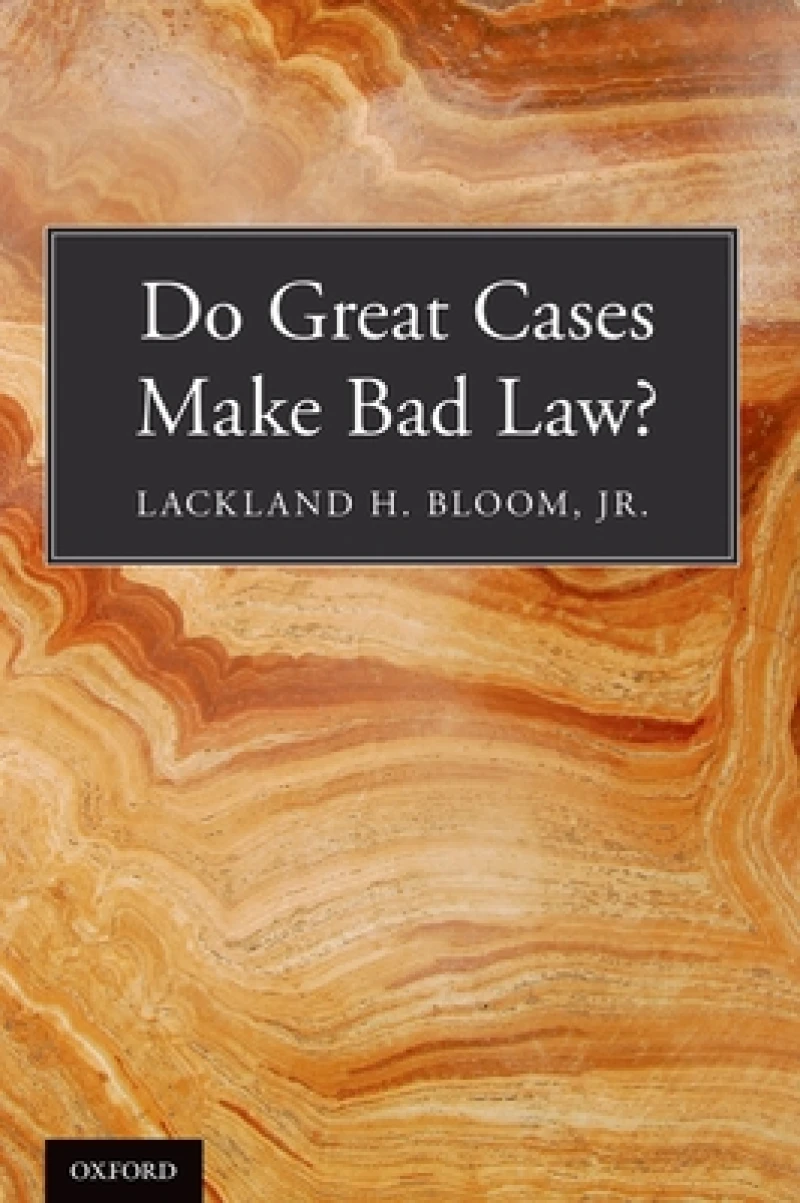
Do Great Cases Make Bad Law?
Book Details
Format
Paperback / Softback
ISBN-10
0190840080
ISBN-13
9780190840082
Publisher
Oxford University Press Inc
Imprint
Oxford University Press Inc
Country of Manufacture
GB
Country of Publication
GB
Publication Date
Oct 12th, 2017
Print length
454 Pages
Weight
689 grams
Dimensions
15.60 x 23.40 x 2.60 cms
Product Classification:
Constitutional & administrative law
AI Summary
Ksh 7,450.00
Manufactured on Demand
0 in stock
Delivery Location
Delivery fee: Select location
Secure
Quality
Fast
"Great cases like hard cases make bad law" was Justice Holmes'' famous aphorism arguing that the pivotal cases attracting Supreme Court attention make for poor bases upon which to construct a general law. In Do Great Cases Make Bad Law?, Lackland H. Bloom, Jr. tests Justice Holmes'' dictum by analyzing in detail the history of the Supreme Court''s great cases, from 1803''s pivotal Marbury v. Madison to 2012''s Patient Protection and Affordable Care Act case. He explains why the Court found a case compelling, how the background and historical context affected the decision and its place in constitutional law and history, and in doing so, synthesizes important analytical scholarship about these cases to form an intricate scholarly understanding of the holistic significance of the Supreme Court''s reasoning in American constitutional law.
"Great cases like hard cases make bad law" declared Justice Oliver Wendell Holmes, Jr. in his dissenting opinion in the Northern Securities antitrust case of 1904. His maxim argues that those cases which ascend to the Supreme Court of the United States by virtue of their national importance, interest, or other extreme circumstance, make for poor bases upon which to construct a general law. Frequently, such cases catch the public''s attention because they raise important legal issues, and they become landmark decisions from a doctrinal standpoint. Yet from a practical perspective, great cases could create laws poorly suited for far less publicly tantalizing but far more common situations.Lackland H. Bloom, Jr. tests Justice Holmes'' dictum in Do Great Cases Make Bad Law? He analyzes in detail the history of the Supreme Court''s great cases, from Marbury v. Madison in 1803, to National Federation of Independent Business v. Sebelius, the Patient Protection and Affordable Care Act case in 2012. He treats each case with its own chapter, and explains why the Court found a case compelling, how the background and historical context affected the decision and its place in constitutional law and history, how academic scholarship has treated the case, and how the case integrates with and reflects off of Justice Holmes'' famous statement. In doing so, Professor Bloom draws on the whole of the Supreme Court''s decisional history to form an intricate scholarly understanding of the holistic significance of the Court''s reasoning in American constitutional law.
Get Do Great Cases Make Bad Law? by at the best price and quality guaranteed only at Werezi Africa's largest book ecommerce store. The book was published by Oxford University Press Inc and it has pages.
Discover books you might love based on this title.
More in This Genre

Staat und Kirchen im francophonen Schwarzafrika und auf Madagaskar
Ksh 6,750.00
The Authoritarians
Ksh 5,050.00

Code of Federal Regulations, Title 32 National Defense 800-End, Revised as of July 1, 2017
Ksh 7,700.00
Constitutional Resilience in South Asia
Ksh 18,100.00
Personal Identity and the European Court of Human Rights
Ksh 27,900.00

Article 47 of the EU Charter and Effective Judicial Protection, Volume 2
Ksh 9,100.00
